


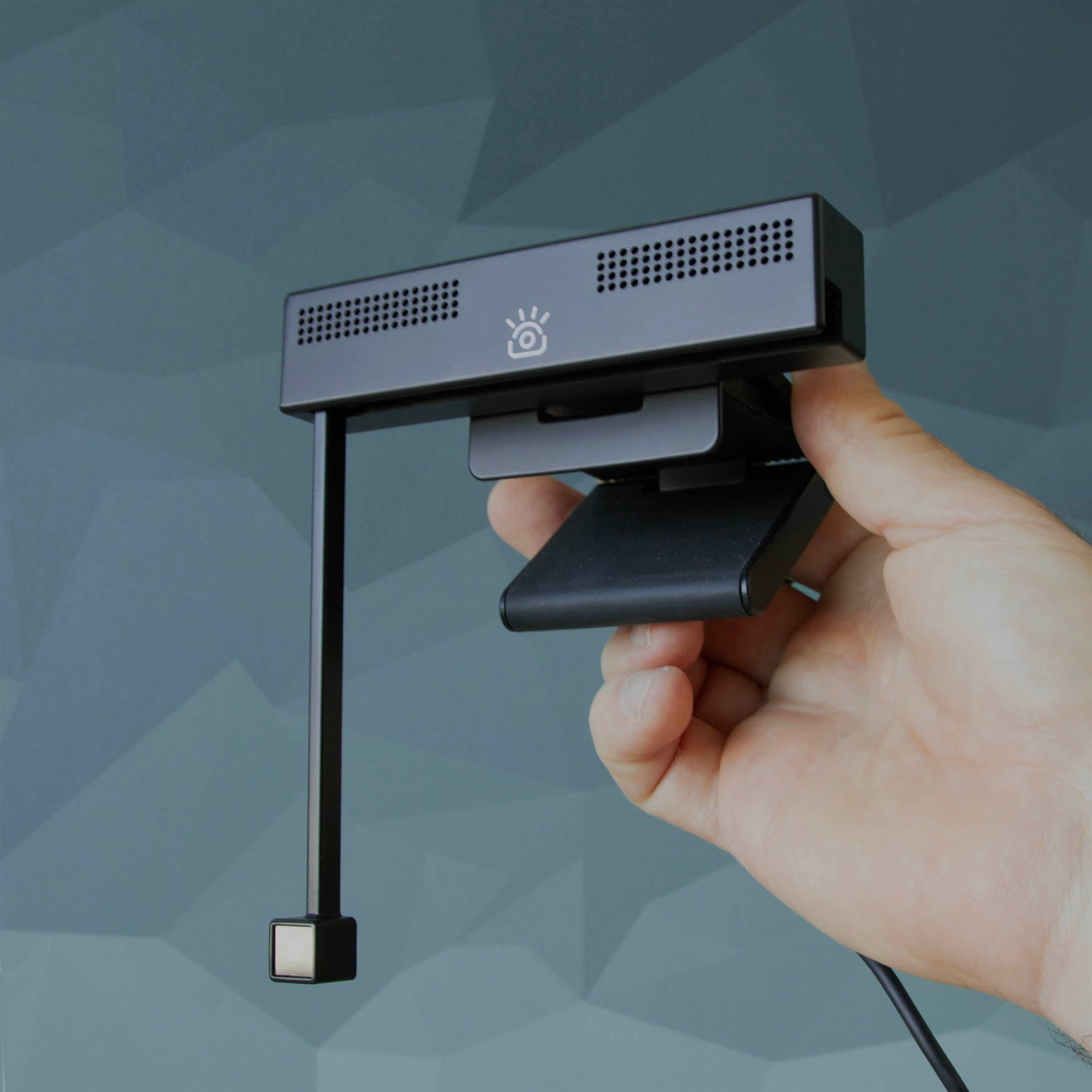
Recently, Forbes Personal Shopper released their guide to the best webcams on the market, prominently recommending the iContact Camera. While hardware reviews often focus strictly on technical specifications like resolution, frame rates, and lighting sensors, the true value of the iContact Camera extends far beyond basic optics. The Forbes recommendation inadvertently highlights one of the most critical breakthroughs in digital communication: solving the biological disconnect of virtual eye contact.
In the modern landscape of remote work, professionals are expected to foster deep connections, negotiate complex deals, and lead teams through a screen. However, decades of psychological and neurobiological research confirm that human connection relies heavily on a behavior that standard webcams actively prevent: mutual gaze.
Here is an in-depth look at the rigorous, peer-reviewed science that explains exactly why specialized hardware like the iContact Camera is not just a technological upgrade, but a biological necessity for effective communication.
The Forbes Verdict: An Elegantly Simple Hardware Solution
The Forbes review captures exactly why standard video conferencing setups fail us and how the iContact line overcomes these physical limitations. As the article notes, the iContact Camera Go solves one of the most common problems with video calls in an elegantly simple way: instead of looking like you’re staring off-screen, it makes it seem as though you’re looking at your audience.
That’s because the iContact Camera Go sticks down into the center of your computer screen thanks to a minimally invasive swing-down camera arm. The lens hovers right at eye level during your call, helping your gaze line up so eye contact feels much more natural. Should you need to multitask, the camera arm is narrow enough that you can easily use your camera and monitor simultaneously. And when each video call is over, you can simply swing the camera arm up and out of the way.
Forbes Vetted executive editor Dave Johnson uses the iContact Camera as his webcam and appreciates that it extends down from the top of his large monitor. “Because my webcam sits more than two feet above my desk—it’s perched high atop a giant 30-inch widescreen monitor—I have to crane my neck at a weird angle to look into the camera in conference calls, or else people just see the top of my head,” he says. “The iContact Camera Pro elegantly solves this problem with its swing-down camera, so I can look straight ahead and still keep eye contact with everyone. The image and sound quality is superb, and the camera swings up and out of the way when I’m not on a call.”
It's also highly versatile, being fully compatible with both Macs and PCs. That said, the review notes a minor audio limitation: while the mono speaker captures sound well, it doesn’t offer stereo HDR. However, the visual communication benefits it provides far outweigh this minor audio constraint. But why does this simple mechanical adjustment matter so much? The answer lies deep in human evolutionary biology.
The Evolutionary Power of the Human Gaze
To understand the profound impact of the iContact Camera, we must first look at human evolution. According to the "Cooperative Eye Hypothesis," humans are unique among primates because we possess a highly visible white sclera surrounding our dark iris. This anatomical adaptation sacrificed the camouflage of our gaze to facilitate high-bandwidth social communication. It allowed early humans to seamlessly track where others were looking, infer their intentions, and coordinate collective actions.
When we lock eyes with another person, it triggers the "Eye Contact Effect". This phenomenon utilizes a rapid subcortical visual processing route—involving the superior colliculus, the pulvinar, and the amygdala—to prioritize face-bound social cues, bypassing slower cortical processing. Instantly, the observer’s brain prepares for interaction, autonomic arousal increases, and attention is captured. For any professional attempting to command a virtual room, effectively utilizing this biological override is the key to anchoring a performance.
The Gaze Angle Problem: Why Standard Webcams Fail
Despite its importance, establishing mutual gaze in video conferencing is notoriously difficult due to a phenomenon known as "skewed visuality" or the "gaze angle problem".
Standard webcams are mounted at the top of a monitor. As Dave Johnson noted with his 30-inch screen, if a user looks at their partner on the screen to read their facial expressions, their gaze appears to be looking down and away from the camera. Conversely, if the user looks directly into the camera lens to simulate eye contact, they can no longer see their partner’s live facial cues. This physical misalignment forces users into a no-win scenario: either sacrifice reading the room, or sacrifice sending the nonverbal signal of attention.
This lack of eye contact has devastating effects on the social dynamics of a meeting. In settings where individuals communicate via video without eye contact, participants experience a sense of both emotional and physical distance. This skewed visuality heightens self-consciousness, limits participatory sensemaking, and often results in users feeling as though they are engaging in separate monologues rather than a unified dialogue. Furthermore, avoiding eye contact in virtual settings makes you come across as less present, which can significantly lower your rating of hireability or competence in professional interviews.
The 2-Degree Rule: Why the iContact Camera Works Perfectly
The iContact Camera solves this structural flaw by utilizing its retractable arm to physically drop the camera lens down directly over the display, placing the lens right between the eyes of the person on your screen. But why does this specific placement work so perfectly? The answer lies in the psychophysics of gaze perception.
Extensive eye-tracking research has revealed a highly counter-intuitive fact about digital eye contact: looking directly into a camera lens does not produce the best perception of eye contact for the viewer. Empirical user studies demonstrate that when an actor looks dead-center into a lens, the viewer perceives them as looking slightly upward.
Instead, the optimal fixation point for the perception of eye contact is actually just below the camera lens. Specifically, looking approximately 2 degrees of visual angle below the center of the camera lens yields the truest perception of mutual gaze. By positioning the iContact Camera directly over the face of the person on your screen, your natural gaze as you look at their image perfectly aligns with this 2-degree sweet spot. This precise alignment allows users to maintain natural, unbroken eye contact while still actively reading the emotional reactions of their counterpart.
The Business ROI: Trust, Sincerity, and Leadership
When you leverage hardware like the iContact Camera to successfully restore eye contact, the professional benefits are staggering. Research quantifying the impact of nonverbal cues on business outcomes reveals massive gains across multiple domains:
- Trust and Sincerity: Eye contact serves as a powerful nonverbal communication tool that conveys trust, respect, and attentiveness. Maintaining consistent eye contact can make an individual seem 50% more engaged. Furthermore, utilizing eye contact as part of a mirroring technique increases overall interpersonal trust scores by 60% to 70%.
- Negotiation and Collaboration: Effective mutual gaze increases the chances of reaching mutually beneficial resolutions in negotiations by 65%. When customers feel seen, they are far more likely to engage. Harnessing the nonverbal communication power of eye contact within the realm of video conferencing not only strengthens professional relationships but also cultivates an atmosphere conducive to open dialogue and creative thinking.
- Leadership and Psychological Safety: In group meetings, leaders who distribute their eye gaze effectively foster environments of high psychological safety. Receiving more eye gaze from a leader significantly decreases feelings of ostracism and directly causes group members to speak up and participate more frequently. This effect is particularly pronounced for introverted individuals, meaning that a leader's virtual eye contact is a powerful tool for empowering diverse voices.
The Neurobiology of Connection: Synchronizing Two Brains
The benefits of the iContact Camera highlighted by Forbes aren't just psychological; they are deeply neurobiological. When two people engage in mutual gaze, they do much more than trade information—they literally synchronize their nervous systems.
Inter-Brain Synchrony (IBS) Hyperscanning technologies, which simultaneously record the brain activity of two interacting individuals, reveal that eye contact acts as the "glue" that binds neural states. Eye contact is associated with significantly higher neural coherence between two brains, specifically in the gamma and theta frequency bands, which govern shared attention, affective empathy, and social bonding. When you look your virtual partner in the eye using a center-screen camera, your brains form a "hyperbrain network" that allows for a highly efficient, real-time exchange of social and cognitive data.
Pupillary and Autonomic Synchrony During a highly engaged conversation, the pupils of both individuals naturally dilate and constrict in tandem. Research shows that this pupillary synchrony rises as interaction partners share attention, reaching its absolute peak at the exact moment eye contact is made. Furthermore, live eye contact triggers autonomic arousal. Studies measuring skin conductance responses (SCR) show that direct gaze elicits significantly larger autonomic arousal compared to an averted gaze. This indicates that the body automatically "engages" and prepares for interaction when it feels observed—an effect that holds true for virtual eye contact just as it does for in-person meetings.
Cognitive Performance: Enhancing Memory and Focus
In addition to building rapport, maintaining eye contact through the iContact Camera can dramatically improve how well your audience remembers your presentation.
Eye contact serves as an arousing stimulus and a nonverbal cue that directs attention to essential information, thereby enhancing focus and reducing distractions. In educational and presentation settings, experiencing direct eye contact from a speaker has been shown to significantly improve the recall of verbal information, such as spoken words and product details.
Eye contact is particularly beneficial for observers with low working memory capacity (WMC). By providing clear, socially communicative signals, a speaker's gaze helps these individuals allocate their attention more effectively, fostering a sense of partnership that improves their overall learning, retention, and enthusiasm for the knowledge presented.
Conclusion: A Biological Upgrade for the Digital Age
When Forbes Vetted recommended the iContact Camera Go and Pro, they were endorsing much more than a high-definition lens; they were recognizing a critical tool for humanizing the digital workspace.
For the modern professional, the eyes are the primary biological mechanism for commanding attention, building trust, and driving emotional synchrony. Relying on standard webcams forces professionals to surrender these evolutionary tools, resulting in awkward, draining, and less persuasive virtual interactions.
By utilizing a swing-down arm to physically align the camera lens with the faces on your screen, devices like the iContact Camera allow you to multitask effortlessly while hitting the optimal 2-degree offset required for authentic perceived eye contact. This simple mechanical shift unlocks a cascade of biological benefits: it spikes inter-brain synchrony, increases your perceived engagement by 50%, boosts interpersonal trust by up to 70%, and commands the psychological safety necessary for robust team collaboration.
Ultimately, mastering the virtual gaze isn't just about looking good on camera—it is about honoring the neurobiological requirements of human connection. By bridging the digital divide with true eye contact, you strip away the artifice of remote work and turn a simple video call into a captivating, highly effective human reality.