

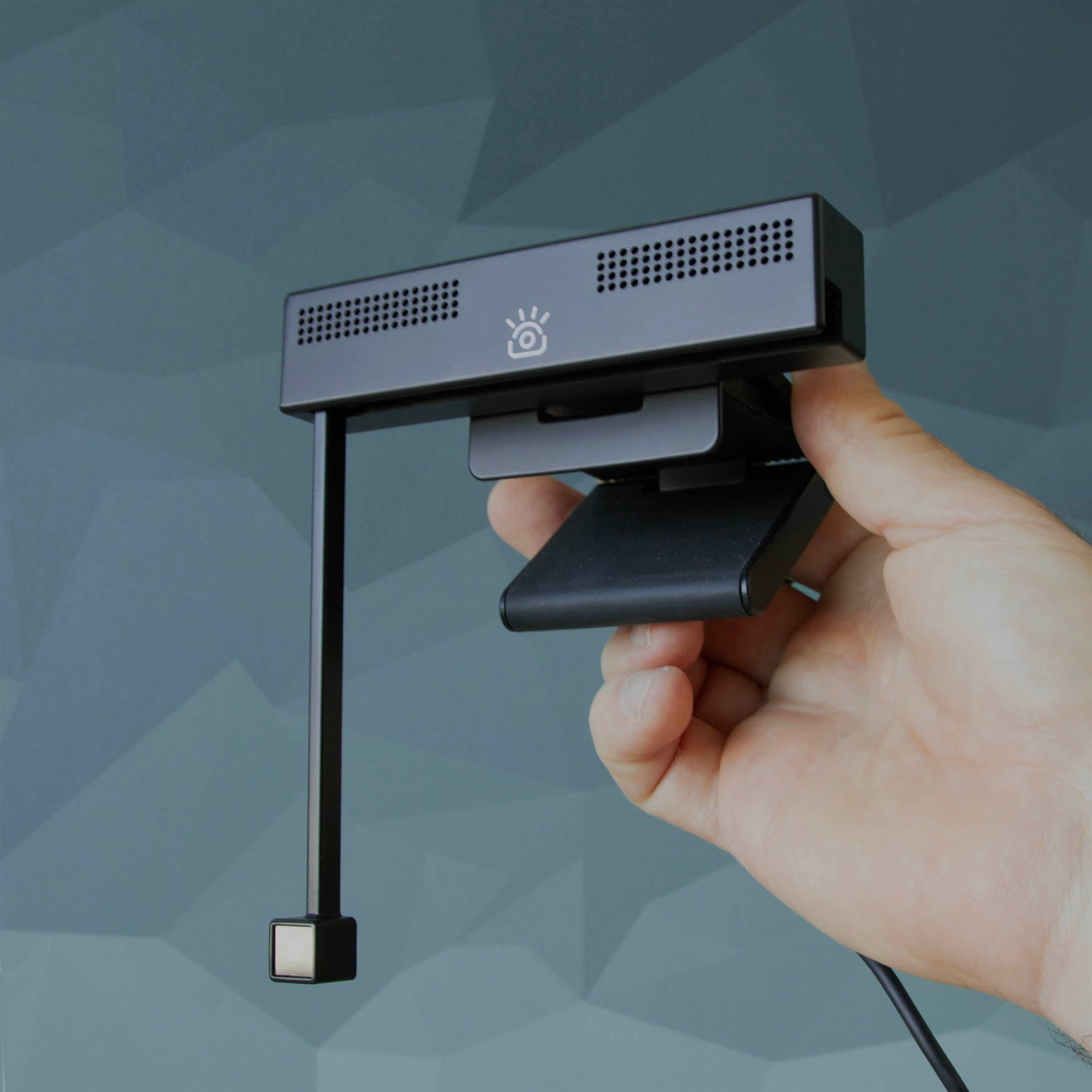
In the modern digital sales environment, professionals are expected to do the impossible: flawlessly deliver complex pitches, actively listen to prospects, handle unpredictable objections, and simultaneously radiate warmth and trustworthiness. Virtual selling via webcam has the potential to be incredibly intimate because of how our brains react to seeing a video of people—it can simulate the feeling of sitting directly across from someone. However, this format also introduces massive cognitive and physical hurdles.
Salespeople must often navigate long-form scripts, bullet points, and product specifications during a call. When they look away to reference these materials, they break the most critical bond of human communication: eye contact. The solution to this modern dilemma lies in the convergence of three powerful tools: center-screen hardware like the iContact Camera, on-screen teleprompters, and dynamic AI-driven sales guidance.
Here is how combining these technologies allows you to deliver highly engaging, script-perfect performances while maintaining the unbreakable trust of your prospects.
The Biological Imperative of Eye Contact in Sales
Before examining the technology, we must understand the profound neurobiological impact of eye contact on consumer behavior and trust. Eye contact is essential in communication, acting as a cornerstone of effective interpersonal connection. Maintaining consistent eye contact, nodding, and staying open can make an individual seem 50% more engaged.
In a sales context, building rapport relies heavily on nonverbal cues. In fact, research indicates that 65% of our communication isn’t through words. When a salesperson utilizes effective eye contact and subtly mirrors a client's body language and tone, they can make customers significantly more engaged. Astoundingly, 82% of clients trust a professional more when their nonverbal cues are effectively mirrored. Direct eye contact also releases oxytocin, a bonding hormone that activates brain systems related to social cognition and empathy.
However, achieving this in a digital environment presents a distinct challenge known as the "gaze angle problem".
The Gaze Angle Problem and the Hardware Solution
The "gaze angle problem" occurs because standard webcams are mounted at the top of a monitor. If a user looks at their partner on the screen, their gaze appears to be looking down and away from the camera. If the salesperson is looking down to drive a slide deck or read a script, a huge disconnect occurs because the prospect's brain processes the interaction as if the salesperson does not care. Conversely, if the salesperson looks directly into the camera lens, they can no longer see their prospect’s facial expressions or reactions.
To solve this, sales professionals are turning to hardware solutions like the iContact Camera. This device physically drops down directly over the display, placing the lens right between the eyes of the person on your screen.
Interestingly, rigorous eye-tracking research reveals a surprising nuance about how we perceive digital eye contact. The optimal fixation point for the perception of eye contact is actually not staring dead-center into the lens; rather, looking approximately 2 degrees of visual angle below the camera lens yields a truer perception of eye contact. By placing the iContact Camera directly over the prospect's face on your monitor, your natural gaze as you look at their image (or read text placed directly over their image) perfectly aligns with this 2-degree sweet spot, creating a highly authentic, trust-building connection.
Eliminating Split Attention with On-Screen Teleprompters
Even with perfect camera placement, salespeople still face the challenge of remembering complex pitches and product data. In the past, reps would have notes on a second monitor or a printed script on their desk. This leads to "split visual attention," a phenomenon where the brain struggles to integrate information when the eyes must constantly dart between a script and a face.
The integration of on-screen teleprompter software changes everything. Modern teleprompter applications can run words directly over the person's image on your screen. By placing your script or bullet points in the exact center of your screen—directly behind the iContact Camera—you can read long-form content while maintaining what the prospect perceives as unwavering eye contact.
This setup allows you to project immense authority and confidence. Because you do not need to look away to remember your lines, you appear incredibly prepared, poised, and knowledgeable. You are effectively speaking "off the cuff" from the prospect's perspective, while in reality, you are safely guided by your on-screen text.
Enter AI: Instant, Dynamic Sales Guidance
While reading a static script is useful for standard presentations, sales is an interactive, unpredictable sport. This is where Artificial Intelligence elevates the teleprompter from a simple reading tool into a dynamic, real-time coaching engine.
Recent advancements in large language models have enabled AI to analyze human conversations and adaptively prompt real-time answers. By integrating AI into your communication workflow, the software listens to the live conversation, processes the prospect's statements, and instantly generates dynamic sales positioning and guidance directly onto your teleprompter screen.
Imagine you are in a high-stakes discovery call. The prospect suddenly mentions a highly specific competitor or throws out a complex technical objection. Instead of panicking, breaking eye contact, and scrambling through your notes, you simply maintain your steady, empathetic gaze. Within seconds, your AI agent feeds bulleted talk-tracks onto the teleprompter overlaid on the prospect's image. You seamlessly deliver the perfect counter-argument, maintaining the ultimate illusion of effortless expertise.
Mastering Objection Handling with AI Support
Objections signal interest, but they require structured handling to maintain the momentum of the deal. One of the most effective frameworks for managing pushback is the A-C-R model—Acknowledge, Clarify, Respond.
When executing this model, nonverbal communication is just as important as what you say. If you look nervous or avert your gaze, the prospect will lose confidence. With dynamic AI guidance and a center-screen camera, you can execute the A-C-R sequence flawlessly:
- Acknowledge: The AI prompts you to validate their concern. You maintain direct eye contact and say, "I appreciate your concern about implementation time."
- Clarify: The AI suggests a specific probing question. You read it effortlessly off the screen: "Can you share which part seems most time-intensive?"
- Respond: As the prospect answers, the AI pulls up the exact data points regarding your rapid onboarding process. You deliver the precise metrics to allay their fears, never once breaking your connection.
This empathetic, visually connected approach reduces resistance and positions your solution as a collaborative win.
Crafting the Perfect Pitch On the Fly
A compelling pitch follows a structured narrative that places the customer at the center of the story. AI-guided teleprompters can help sales reps build this narrative in real-time, adapting the Problem–Solution–Outcome frameworkbased on cues dropped earlier in the conversation.
As you present, the dynamic prompter can feed you the five crucial elements of a winning pitch:
- Hook: A relatable challenge based on the client's specific industry.
- Insight: An unexpected data point fetched instantly by the AI.
- Solution: How your features directly solve the challenge they just mentioned.
- Proof: A brief case example or testimonial dynamically selected by the AI based on the prospect's company size.
- Call to Action: A clear proposal for the next step with a specific timeline.
By structuring pitches this way—and delivering them with the sustained eye contact that increases perceived sincerity by 50%—prospects easily envision specific benefits and move swiftly toward commitment.
Scaling High-Performance Communication
For small businesses and growing sales teams, the biggest barriers to success are inconsistent messaging and a lack of on-the-fly training. Utilizing dynamic on-screen guidance essentially puts your best sales manager in the room for every single call. It standardizes outreach, maintains brand voice, and ensures key points are addressed without sacrificing the personal touch.
Furthermore, maintaining "virtual" eye contact by looking at the camera can significantly improve the quality of communication in remote work environments. It keeps the audience engaged because they feel like you are talking directly to them. When you combine the psychological power of the gaze with the cognitive support of an AI-driven teleprompter, you eliminate the cognitive load of trying to remember every product detail. You no longer have to burn mental calories trying to formulate the perfect response to a surprise question; the AI handles the data retrieval, allowing you to focus 100% of your human energy on empathy, tone, and building rapport.
Conclusion
In an era where remote selling is the norm, the professionals who win are those who can bridge the digital divide and make their clients feel truly seen and understood. Eye contact is the foundational building block of that trust. By utilizing hardware like the iContact Camera to align your gaze, and leveraging on-screen teleprompters powered by dynamic AI guidance, you create an insurmountable competitive advantage. You gain the ability to deliver complex, script-aligned content, handle objections with real-time intelligence, and maintain the steady, empathetic eye contact that turns prospects into lifelong partners.