

In the hyper-competitive landscape of talent acquisition, hiring managers and recruiters are inundated with perfectly polished resumes, AI-optimized cover letters, and flawlessly rehearsed interview answers. However, the true measure of a candidate—their integrity, interpersonal communication skills, and cultural fit—rarely translates on paper. To evaluate these crucial human elements, recruiters must look beyond the written word and rely on the oldest, most powerful nonverbal communication tool in human history: eye contact.
Decades of neurobiological and psychological research reveal that the human gaze is not merely a tool for gathering visual information; it is a highly active regulatory mechanism that shapes interpersonal trust, reveals character, and dictates the success of a professional relationship. By understanding the science of eye contact, recruiters can decode a candidate's true potential, assessing their communication proficiency and underlying integrity in ways a resume never could.
Beyond the Resume: The Biology of First Impressions
To understand why eye contact is so critical in a recruiting scenario, we must first look at human evolutionary biology. According to the "Cooperative Eye Hypothesis," humans are unique among primates because we possess a highly visible white sclera surrounding our dark iris. This anatomical adaptation sacrificed the camouflage of our gaze to facilitate high-bandwidth social communication, allowing us to seamlessly track where others are looking, infer their intentions, and coordinate our actions.
When a recruiter locks eyes with a candidate, it triggers the "Eye Contact Effect". This phenomenon utilizes a rapid subcortical visual processing route—involving the superior colliculus, the pulvinar, and the amygdala—to prioritize face-bound social cues, bypassing slower cortical processing. Instantly, the observer’s brain prepares for interaction, autonomic arousal increases, and attention is captured.
For the candidate, effectively utilizing this biological override is the key to commanding a room. Studies have found that individuals who do not make adequate eye contact during an interview are often viewed as unattractive, detached, passive, incompetent, and lacking composure. Conversely, maintaining consistent eye contact, accompanied by open posture, makes an individual appear 50% more engaged in the interaction. For recruiters, a candidate's ability to navigate this biological dance is the first indicator of their real-world communication skills.
Signaling Conscientiousness and Professional Diligence
While resumes list past achievements, eye contact provides real-time data on a candidate's personality traits—most notably, their conscientiousness. Conscientiousness, defined by a high degree of discipline, persistence, and diligence, is consistently identified as the best noncognitive predictor of job performance and overall employability.
Recent peer-reviewed research utilizing mobile eye-tracking in naturalistic leader-follower interactions (akin to a recruiter-candidate dynamic) demonstrates that conscientiousness shapes an individual's eye-directed gaze behavior. More conscientious candidates specifically instrumentalize their gaze when speaking, directing it at the evaluator to support their arguments.
Why is this the case? Exhibiting and maintaining eye contact requires significant cognitive resources, particularly while speaking and formulating answers. Less conscientious candidates who try to improvise or feign preparedness deplete their cognitive resources quickly, resulting in broken gaze and erratic eye movements. Because highly conscientious individuals prepare diligently, their cognitive resources are freed up, allowing them to afford the "cost" of maintaining steady eye contact while articulating their points. In this way, sustained eye contact serves as an honest, biological signal of a candidate's work ethic and preparation.
The Integrity Metric: How Gaze Influences Honesty
A recruiter's paramount concern is whether a candidate is misrepresenting their skills. While folk wisdom has long associated averted gaze with deception, the scientific reality is that the presence of eye contact actually forces integrity.
Empirical research confirms that eye contact significantly reduces lying. The mechanism behind this lies in the profound effect of being watched. When humans feel they are being observed, it triggers a state of public self-awareness and activates reputational concerns. The presence of direct gaze lifts the "veil of anonymity," encouraging individuals to behave in a more prosocial, honest manner to avoid negative social evaluation.
Furthermore, maintaining consistent eye contact increases a speaker's perceived sincerity by 50%. When a candidate maintains steady mutual gaze while discussing their past experiences, they are not only signaling confidence but also engaging in a biological commitment to the truth. In a profession where hiring a dishonest candidate can cost a company thousands of dollars and damage team morale, paying attention to this nonverbal anchor of integrity is indispensable.
The "Chemistry" of a Good Hire: Inter-Brain Synchrony
When recruiters speak about a candidate being a "great cultural fit" or having "good chemistry," they are often unconsciously referring to physiological and neural alignment. Human communication is incredibly complex, and researchers estimate that nonverbal cues account for roughly 65% to 70% of total human communication.
When a recruiter and a candidate engage in mutual gaze, they are doing much more than trading interview questions; they are literally syncing their nervous systems. The advent of hyperscanning technologies—which record two interacting brains simultaneously—has revealed that eye contact acts as the "glue" that binds neural states, a phenomenon known as Inter-Brain Synchrony (IBS).
Eye contact is associated with significantly higher neural coherence between two brains, specifically in the gamma (30-45 Hz) and alpha frequency bands, which govern shared attention, affective empathy, and social bonding. Furthermore, during a highly engaged conversation, the pupils of both individuals naturally dilate and constrict in tandem. This pupillary synchrony rises as conversation partners share attention, reaching its absolute peak at the exact moment eye contact is made. This shared biological rhythm dictates the organic flow of the conversation, allowing the recruiter and candidate to build mutual trust and empathy.
Navigating the Virtual Interview: The Gaze Angle Problem
As the recruiting landscape has shifted toward remote work, video interviews have become the standard. However, virtual interviews introduce a massive technological barrier to assessing communication and integrity: the "gaze angle problem".
Standard webcams are mounted at the top of a monitor. If a candidate looks at the recruiter's face on the screen to read their emotional reactions, their gaze appears to be looking down. If the candidate looks directly into the camera lens to simulate eye contact, they can no longer see the recruiter's facial cues. This disconnect destroys the very Inter-Brain Synchrony required to establish trust.
The consequences of this disconnect are severe. Eye-tracking research on video interviews reveals that looking off to the side horizontally makes a candidate seem significantly less hireable and less present, which can dramatically lower their overall rating.
To solve this, candidates and recruiters must understand the psychophysics of digital gaze. Counterintuitively, looking dead-center into a camera lens is often perceived as an unnatural, upward stare by the viewer. Instead, the optimal fixation point for the truest perception of eye contact is approximately 2 degrees of visual angle below the camera lens.
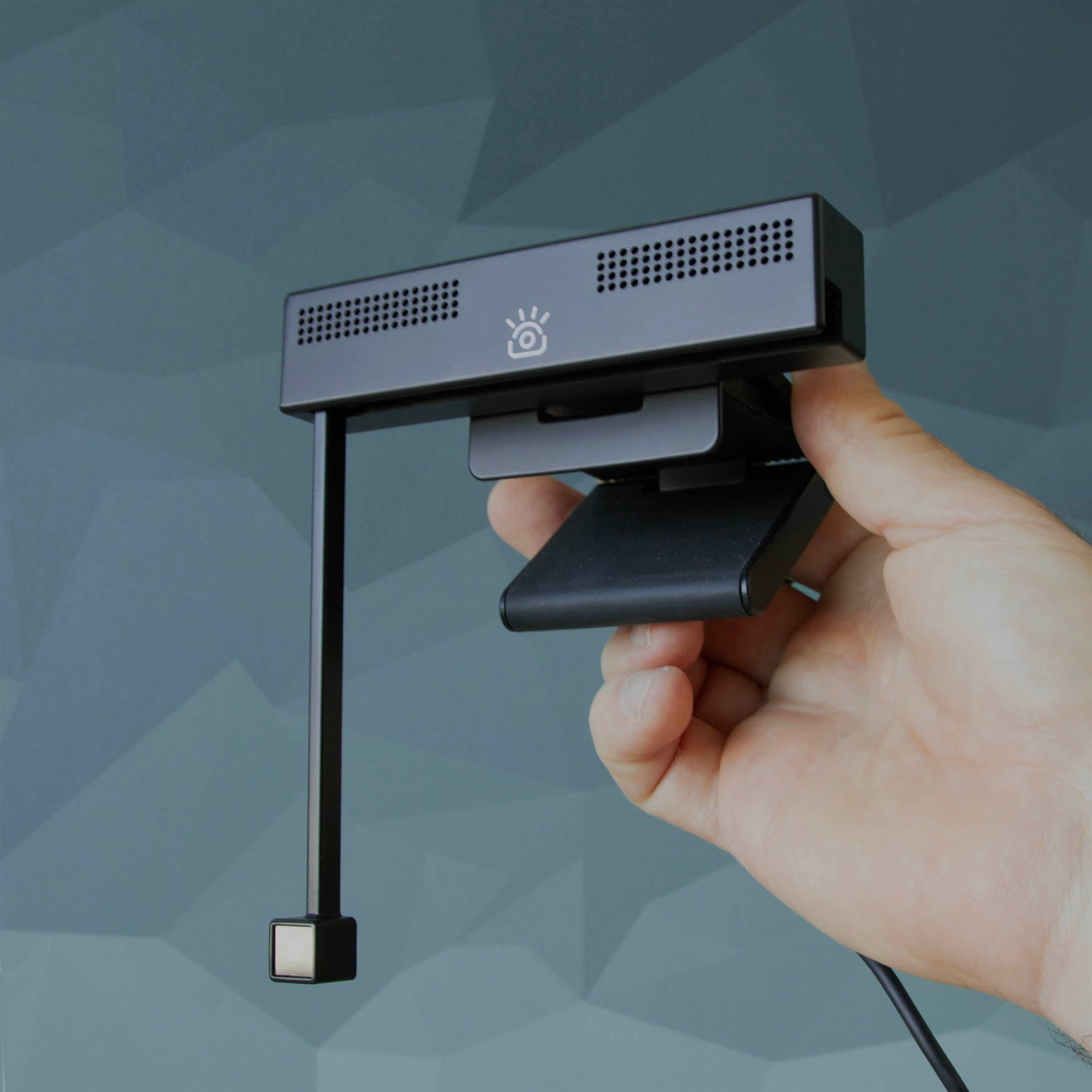
Innovative hardware solutions, such as center-screen webcams (like the iContact Camera), are being adopted by professionals to physically solve this issue. These devices drop the camera lens down over the display, placing it directly between the eyes of the person on the screen. By aligning the lens with the face, candidates can read the recruiter's micro-expressions while their natural gaze perfectly hits that 2-degree sweet spot, facilitating authentic emotional connection and preserving the integrity signals of mutual gaze.
Best Practices: The 50-70% Rule
While eye contact is undeniably powerful, recruiters and candidates alike must calibrate its use. An unbroken, unblinking stare can activate the amygdala's threat pathways, triggering a fight-or-flight response and coming across as aggressive or intimidating.
To project confidence, sincerity, and conscientiousness without causing discomfort, communication experts recommend the 50-70% rule. Candidates should aim to maintain eye contact for roughly half to three-quarters of the interaction. It is entirely natural, and even encouraged, to break gaze temporarily when formulating a complex thought or referencing notes. This natural rhythm—engaging during important points and allowing for brief visual breaks—demonstrates high emotional intelligence and conversational competence.
Conclusion
In the modern recruiting process, the resume is merely the ticket to entry. The actual decision of whether an individual possesses the integrity, conscientiousness, and communication skills to thrive within an organization is determined in the interview room.
Eye contact is the biological foundation of that determination. It is a transcultural, evolutionary mechanism that forces honesty, commands attention, and physically synchronizes the brains of the speaker and the listener. By recognizing the profound socio-cognitive architecture behind mutual gaze, recruiters can transcend the superficial bullet points of a resume and make hiring decisions grounded in authentic human connection.